QUANTUM FRAME
LITTLE SOUND MACHINES
LITTLE SOUND MACHINES
2019 -
2018
2018
The Quantum Frame is a mechanical installation that speculates on the future of quantum computing and what that may hold for machine intelligence and consciousness. The installation takes the form of the present day quantum computer, with a tubular central chamber, where machine learning data drives the mechanical movements of an electromagnetic structure, breathing life into the metallic framework, a ghost in the machine.
The current version of the frame is self-generative. But the artist hopes that once time-sharing of the quantum computer is open to the general public, that the installation may be able to talk with the quantum machine directly via data transfer.
This piece is currently on-going. Magnetic field experimentation and research with ferrofluid are currently in--progress.
The Little Sound Machines is a sound installation consisting of a series of both mechanical and digital machines that are connected to an AI network. Three AIs form the central brain of the network. Through learning from and influencing each other, the AIs construct the musical phrases that are then played out through a series of sound-generating machines. The music generated by the AI is also presented on a series of television screens that visualizes both the AI data and audio, as well as machine logic and behavior to the audience.
This piece proposes a new mode of music creation in the age of intelligent machine. Through experimentation, the artist presents an exploration of new musical interfaces that erases the composer from the equation, to present a purely machine-made performance.
The Little Sound Machines are made from found objects, up-cycled and spare parts.
The Little Sound Machines is a sound installation consisting of a series of both mechanical and digital machines that are connected to an AI network. Three AIs form the central brain of the network. Through learning from and influencing each other, the AIs construct the musical phrases that are then played out through a series of sound-generating machines. The music generated by the AI is also presented on a series of television screens that visualizes both the AI data and audio, as well as machine logic and behavior to the audience.
This piece proposes a new mode of music creation in the age of intelligent machine. Through experimentation, the artist presents an exploration of new musical interfaces that erases the composer from the equation, to present a purely machine-made performance.
The Little Sound Machines are made from found objects, up-cycled and spare parts.
LITTLE SOUND MACHINES
2018
The Little Sound Machines is a sound installation consisting of a series of both mechanical and digital machines that are connected to an AI network. Three AIs form the central brain of the network. Through learning from and influencing each other, the AIs construct the musical phrases that are then played out through a series of sound-generating machines. The music generated by the AI is also presented on a series of television screens that visualizes both the AI data and audio, as well as machine logic and behavior to the audience.
This piece proposes a new mode of music creation in the age of intelligent machine. Through experimentation, the artist presents an exploration of new musical interfaces that erases the composer from the equation, to present a purely machine-made performance.
The Little Sound Machines are made from found objects, up-cycled and spare parts.
HOROLOGIC SOLUM
electronics, tape machines, magnetic tape, wood, stainless steel
2020-2021
artists: Benjamin Bacon, Vivian Xu
“On August 20th and September 5th, 1977, two extraordinary spacecraft called Voyager were launched to the stars. ... Affixed to each Voyager craft is a gold-coated copper Phonograph record as a message to possible extraterrestrial civilizations that might encounter the spacecraft in some distant space and time.”
– Carl Sagan, F. D. Drake, Ann Druyan, Timothy Ferris, Jon Lomgberg, Linda Salzman Sagan, “Preface”, Murmurs of Earth: The Voyager Interstellar Record, 1978
Horologic, Greek, of or related to horologe or horology, the science of measuring time or the art of making instruments for indicating time.
– Merriam-Webster Dictionary
Solum, Latin, alone, having no companion, on one’s own.
– Oxford Latin Dictionary
Horologic Solum is a sound installation that explores media memory, its configurative logic, materiality, cultural functionality, and the information that gets stored on it, distorted, decayed, reinterpreted, and forgotten. By examining the NASA Golden Record as a complex archival object, the piece situates the archive and communication technologies within expansive stretches of space and time, to further interrogate what it means to archive and the meaning that is left behind.
The installation operates within a constructed mechanical loop system, consisting of two rectangular pedestals each with a tap machine, a timer, and a cassette tape cycling system. The contents of the Voyager Record are transmitted onto pre-recorded tape. Each day, a new segment runs through a "system of decay," as the cycling system erodes the tape's materiality. Meaning and memory dissolve through material destruction — the installation sonifies this erasure. The timer keeps a steady count of time elapsed until the media dies. The remnants of broken tape are collected by the artist and archived as material evidence of the exhibition.
Five layers of temporal stratification cascade through the installation that connects the audience to past, present, and future:
1) Inscription: The time of original inscription when the original artifacts were produce in early 1977.
2) Cultural Re-Enactment: The time of cultural memorialization of the artifact and it launch as cultural repercussions of the original event, including the publication of the book Murmurs of Earth in 1978, the release of the 1992 commercial CD version of the recorded audio, and the 40th anniversary Ozma Records release of a vinyl version of the Golden Record as a boxed set.
3) Machine Time: The innate time of the medium, measured through the tape deck. Each day, the number of loop repititons are recorded before the tape spontaneously breaks.
4) Performance Time: The time of the performance of the media, which begins at the start of play and ends when the tape breaks, recorded in seconds.
5) Real Time: The time and space in which the audience is present with the artwork – the time and space of the exhibition.
This work was commissioned by the Science, Technology, and Art (STArts) Festival for the Final Prophet exhibition.
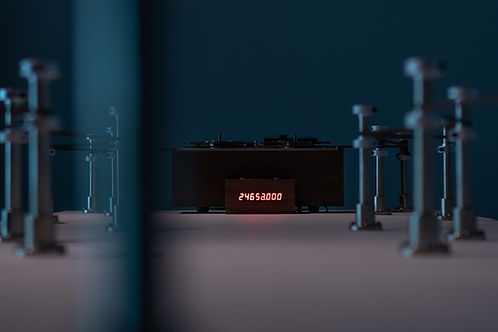


Installation view of piece. Shenzhen Science, Technology and Arts (STArts) Festival, 2020-2021.
Horologic Solum, video, Science, Technology & Arts (STArts) Festival, 2020-2021. 3min 10sec.


Horologic Solum, installation stills, Science, Technology & Arts (STArts) Festival, 2020-2021