QUANTUM FRAME
LITTLE SOUND MACHINES
LITTLE SOUND MACHINES
2019 -
2018
2018
The Quantum Frame is a mechanical installation that speculates on the future of quantum computing and what that may hold for machine intelligence and consciousness. The installation takes the form of the present day quantum computer, with a tubular central chamber, where machine learning data drives the mechanical movements of an electromagnetic structure, breathing life into the metallic framework, a ghost in the machine.
The current version of the frame is self-generative. But the artist hopes that once time-sharing of the quantum computer is open to the general public, that the installation may be able to talk with the quantum machine directly via data transfer.
This piece is currently on-going. Magnetic field experimentation and research with ferrofluid are currently in--progress.
The Little Sound Machines is a sound installation consisting of a series of both mechanical and digital machines that are connected to an AI network. Three AIs form the central brain of the network. Through learning from and influencing each other, the AIs construct the musical phrases that are then played out through a series of sound-generating machines. The music generated by the AI is also presented on a series of television screens that visualizes both the AI data and audio, as well as machine logic and behavior to the audience.
This piece proposes a new mode of music creation in the age of intelligent machine. Through experimentation, the artist presents an exploration of new musical interfaces that erases the composer from the equation, to present a purely machine-made performance.
The Little Sound Machines are made from found objects, up-cycled and spare parts.
The Little Sound Machines is a sound installation consisting of a series of both mechanical and digital machines that are connected to an AI network. Three AIs form the central brain of the network. Through learning from and influencing each other, the AIs construct the musical phrases that are then played out through a series of sound-generating machines. The music generated by the AI is also presented on a series of television screens that visualizes both the AI data and audio, as well as machine logic and behavior to the audience.
This piece proposes a new mode of music creation in the age of intelligent machine. Through experimentation, the artist presents an exploration of new musical interfaces that erases the composer from the equation, to present a purely machine-made performance.
The Little Sound Machines are made from found objects, up-cycled and spare parts.
LITTLE SOUND MACHINES
2018
The Little Sound Machines is a sound installation consisting of a series of both mechanical and digital machines that are connected to an AI network. Three AIs form the central brain of the network. Through learning from and influencing each other, the AIs construct the musical phrases that are then played out through a series of sound-generating machines. The music generated by the AI is also presented on a series of television screens that visualizes both the AI data and audio, as well as machine logic and behavior to the audience.
This piece proposes a new mode of music creation in the age of intelligent machine. Through experimentation, the artist presents an exploration of new musical interfaces that erases the composer from the equation, to present a purely machine-made performance.
The Little Sound Machines are made from found objects, up-cycled and spare parts.
LABS
DUKE-DKU PRESENCE LAB
DUKE KUNSHAN UNIVERSITY & DUKE UNIVERSITY
2025 -
The Duke-DKU Presence Lab draws from fields within media arts, digital media, and the humanities, in the context of theory, history, critical practice, and global conversations, to explore pressing topics at the intersection of computation, media, and culture. We are interested in the future of reality in a digitally hybrid world, and how embodied, engaged communities can thrive across space and time. The question we are raising is whether we can create a deeper sense of connection across locality through meaningful, sustained, and creative synchronous and asynchronous exchanges. In our initial cycle, the group will focus on questions of presence, virtuality, artificial intelligence, agency, and materiality.
Directors:
Benjamin Bacon (Duke Kunshan University)
Victoria Szabo (Duke University)
Associate Directors:
Vivian Xu (Duke Kunshan University)
Mark Olson (Duke University)

DESIGN, TECHNOLOGY & RADICAL MEDIA STUDIO [DTRM STUDIO]
DUKE KUNSHAN UNIVERSITY
2020 -
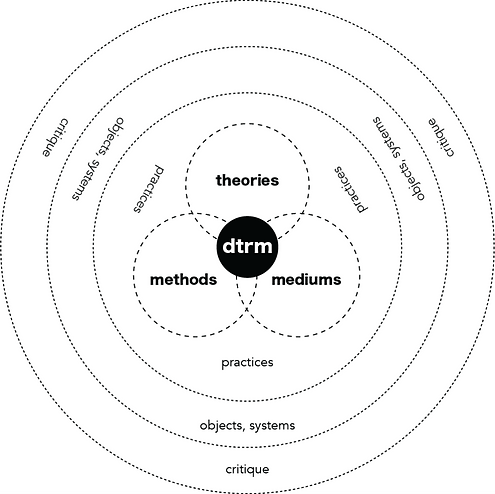
The Design, Technology and Radical Media Studio consists of three foundational labs: the Disruptive Technologies Lab, the Material Ecologies Lab, and the Digital Societies Lab. These lab investigate creative production at the intersection of physical and technological media, biological media, and digital media.
The studio is co-led by artists Benjamin Bacon and Vivian Xu.
2013 - 2020
DOGMA LAB
DOGMA Lab is a cross-disciplinary art and design lab based in Shanghai and Kunshan, China. Founded by Benjamin Bacon and Vivian Xu, we believe in the cross-pollination of Design, Technology, Art and Science in the creation of products, as well as experimental works in art, music, and performance.
We are interested in fostering an environment that uses ideas and concepts developed in research and experimentation to drive and elevate production, forming a sustainable ecosystem of intellectuals and artisans. Through our work, we hope to build a community and hub where creatives from diverse backgrounds can come together to exchange ideas and inspiration, and more importantly, create unique and culturally rich projects, narratives and experiences.

SHANGHAI / KUNSHAN
Our 2017 Xintiandi Christmas Installation press reviews and interviews: Shanghai Daily, SmartShanghai, RADII, IDEAT Magazine, etc. See images of project below.


2012-2013

RAWR! LABS
Caochangdi District, BEIJING
In 2012, Benjamin Bacon along with industrial designer Li Naihan co-founded RAWR! Labs, a Beijing-based design incubator and laboratory that promotes cross-disciplinary design research and production. We were the initiators and production partners of Beijing Design Week Caochangdi.
Read Zandie Brockett's review of the lab Jing Daily.

Community work space.

Woodworking factory.
2006-2010
SPYLAB
PARSONS NEW SCHOOL FOR DESIGN
Founded in 2006 by Prof. Sven Travis and Benjamin Bacon, the SpyLab is a research group and artist collective that investigates illicit international data collection, provision and manifestations within design and art. SpyLab has collaborated with international institutes such as V2_Lab for Unstable Media, the Technology, Arts, Science and Media Lab at Tsinghua University, the Dutch Electronic Arts Festival, the Royal College of Arts, etc.
2009 Control : Print exhibition in collaboration with Royal College of Art (London).
